|
Toa Payoh
Vets Clinical Research
Making veterinary surgery alive
to a veterinary student studying in Australia
using real case studies and pictures |
Facial Abscesses in Rabbits
Dr
Sing Kong Yuen, BVMS (Glasgow), MRCVS
04 April, 2011 |
 toapayohvets.com toapayohvets.com
Be Kind To Pets
Veterinary Education
Project 2010-0129 |
Rabbit case
study No. 1. Rabbit facial abscesses was recorded in 1988
Updated April 04, 2011.
 "What
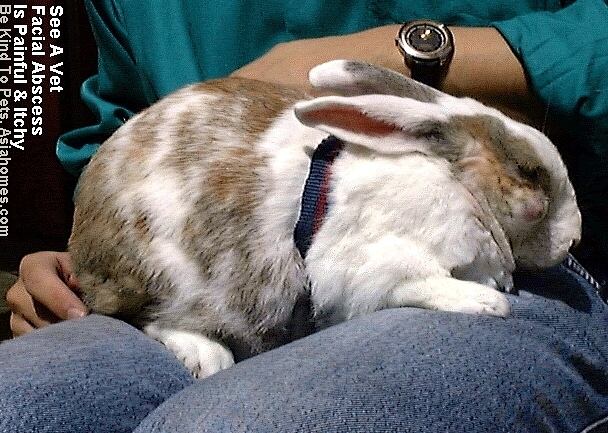
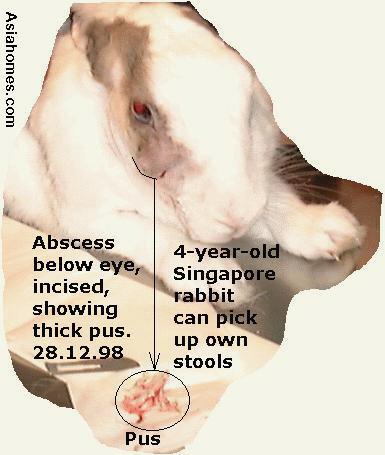
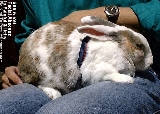
is the cause of this big swelling?" Ms Tan asked of her rabbit.
It had a habit of picking up its own stools and eating them even
at the age of four years. The round soft lump was below the
right eye and the rabbit had rubbed against it, trying to get
rid of the abscess which is a wall of dead bacteria and white
blood cells in a creamy mass. "What
is the cause of this big swelling?" Ms Tan asked of her rabbit.
It had a habit of picking up its own stools and eating them even
at the age of four years. The round soft lump was below the
right eye and the rabbit had rubbed against it, trying to get
rid of the abscess which is a wall of dead bacteria and white
blood cells in a creamy mass.
"It started as a small hard lump. How much it would cost to
treat this rabbit?"
"The cost varies, depending on whether X-rays and surgery are
required.. Was the rabbit free to roam about in your apartment?"
I asked Ms Tan who travelled a lot in her work and who
read a lot about rabbits.
"All rabbits will chew their cage wires, telephone wires and
everything they can lay their teeth on when let loose in the
apartment. It is possible that the sharp objects may
penetrate the inside of the mouth or the tooth root might get
infected.
The veterinary treatment of the rabbit would ideally involve
general anaesthesia so that there would be no pain when I remove
the entire abscess which had a thick wall.
Blood tests, a bacterial check for the abscess and an X-ray
to check whether the facial bones were infected would be
complete.
This was in 1998 when a white rabbit was worth Singapore five
dollars while a pedigree dog was worth much more, above five
hundred to a thousand dollars.
The treatment should involve blood test to check the immune
status of the rabbit, X-rays of the abscess to see if the tooth
root and bone of the jaw was infected, general anaesthesia and
the surgical removal of the abscess as a whole lump to prevent
further infection. The total costs could amount to over
two hundred dollars and could be used to buy over forty new
rabbits!
Therefore, it was pragmatic to buy a new rabbit if the incumbent
had disease, in this case, a big facial abscess which required
treatment costing more than a hundred dollars. |
The abscess
was lanced with a scalpel and the thick pus, characteristic of
all rabbits' abscess was squeezed out.
This was not a satisfactory method of treatment as the
abscess would form again even though antibiotic "beads" or gauze
or the dental calcium hydroxide were packed into the abscess to
eliminate all bacteria but lancing was the least costly.
The rabbit was not seen again. The rabbit's pus is thick
because it does not have the enzymes to liquefy it, as in the
dog or in people.
Note: Abscesses in rabbits can be caused by general
infection of the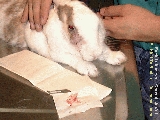 blood by bacteria. Abscesses of the head may be secondary to
dental disease, food packed between the tooth and gingiva, tooth
fracture, tooth root abscess, or a foreign body.
blood by bacteria. Abscesses of the head may be secondary to
dental disease, food packed between the tooth and gingiva, tooth
fracture, tooth root abscess, or a foreign body.
They occur in rabbits of all ages and frequently develop rapidly
(in a matter of a few days). The abscess is usually not painful
and the rabbit appears clinically unaffected.
 When
teeth are involved the rabbit may become completely or partially
not eating. The abscess may be soft or firm but frequently they
have a soft center. They are usually not moveable and when bone
is involved there may be bony swelling as well. The wall of the
abscess is very thick and usually contains bacteria. When
teeth are involved the rabbit may become completely or partially
not eating. The abscess may be soft or firm but frequently they
have a soft center. They are usually not moveable and when bone
is involved there may be bony swelling as well. The wall of the
abscess is very thick and usually contains bacteria.
The pus is caseous, thick, and creamy white in appearance. Of
all abscesses occurring in rabbits, retrobulbar and skull
abscesses are considered to be the most difficult to treat.
TREATMENT AT TOA PAYOH VETS
In 2005, veterinary costs are kept to as low as possible by
not X-raying the rabbit. However, owners will be given an
estimate of the X-rays and total costs of the treatment of
facial abscesses if X-rays are needed. Some rabbits may
need to be warded for daily antibiotic injections although some
veterinarians do give such injections to the owner for home
treatment.
More cases at:
Rabbits |
|
|
|
|
|
|
To
make an appointment: e-mail
judy@toapayohvets.com
tel: +65 9668-6469, 6254-3326 |
toapayohvets.com
Be Kind To Pets
Veterinary Education
Project 2010-0129 |
|
|
|
Copyright ©
Asiahomes
All rights reserved. Revised: April 04, 2011
Toa Payoh Vets
| |
 TOA
PAYOH VETS
TOA
PAYOH VETS